How I book meetings for only 21 cents.
Get so many inbound leads you have to turn people away.
In February 2026 my LinkedIn had under 10 followers and I had never posted. Today it is my number one source of leads.
Here is the part that matters. A booked meeting used to cost me about $4 through cold email and paid ads. On LinkedIn it costs 21 cents. Same quality of meeting, a fraction of the price, and the buyers come to me instead of the other way around.
This is the exact system that did it. Five parts: your profile, your content, your lead magnets, your DMs, and your outreach. Read them in order and copy each one. No ads, no cold calling, no posting every day.
- Chasing buyers through cold email and ads
- About $4 per booked meeting
- Invisible to the people who would pay me
- Under 10 followers, never posted
- Warm inbound buyers in my DMs every week
- 21 cents per booked meeting
- Buyers come to me, already interested
- My number one lead channel
This is the same system we run for clients at OVRHAUL. You can read it and build it, or you can have us run the engine and spend ten to fifteen minutes a week approving posts.
If you already know you would rather have this running than spend the next 90 days building it, book a call and we will see if it is a fit. If you would rather build it yourself, perfect. Keep reading. I am holding nothing back.

The Profile That Closes Before You Show Up
Most profiles read like a résumé. Yours needs to work like a landing page.
Your profile is not a bio. It is a conversion asset. Every time someone sees your post, clicks your name, or finds you in search, your profile is either qualifying them or losing them. Most do neither. They list job titles, a vague summary, and a headshot from 2019. We call the optimized version the silent closer. It works while you sleep.
Visitors decide fast. Your profile has to answer three things before they scroll away:
- Who do you help?
- What outcome do you create?
- What proof backs it up?
Start with the headline. Not your title. Your outcome. Weak: "Founder at Deeploom | AI Enthusiast | Helping businesses grow." Strong: "I build AI growth systems for B2B founders. Content, outreach, and lead gen on autopilot. No hiring. No manual work."
I help [who you help] get [the outcome] without [the thing they hate]. [One line of proof or how].
The banner reinforces it. Use it to state a result or one line on what you do. Canva turns that into a 20-minute job. The About section is where most people write a career story nobody asked for. Rewrite it as a sales page:
[The problem your client is living with right now.]
[The outcome you create + one or two specific numbers.]
[Who you do it for and how it works, one sentence.]
[One CTA. Just one.]
Positioning gets attention. Proof closes it. Your Featured section is the most wasted space on LinkedIn. Use it to stack credibility fast: a post that performed, a lead magnet or case study PDF, a testimonial screenshot, and a link to book a call. One primary action. Put your Calendly at the end of it and remove every click between "I'm interested" and "I'm booked."
| Profile section | What it should do | What most people do wrong |
|---|---|---|
| Headline | State the outcome and who you help | Lists job title or company name |
| Banner | Reinforce positioning with proof | Generic gradient or blank |
| About | Problem, solution, proof, one CTA | Career timeline nobody asked for |
| Featured | Stack proof, route to one action | Empty or links to old posts |
| Experience | Show results, not responsibilities | Copy-paste from a résumé |
Content Written From Your Business, Not the Feed
The best LinkedIn post does not come from a trending topic. It comes from your last sales call.
Write from your own business, not the feed. Copying what is trending gets you generic engagement from people who will never buy, and when a prospect gets on a call and you are not who they thought they followed, the deal dies. Your best content is already sitting in your sales calls.
Step 1: Harvest your sales calls. Your content calendar is sitting in your sales calls, client conversations, onboarding notes, and DMs. After every call, write down the two or three questions or objections that came up. Not the ones you handled perfectly. The ones that made you pause. Those are what your market is thinking but not saying. Each one becomes a post.
Step 2: Borrow concepts, not content. LinkedIn now flags AI-looking content, and the moment one big account posts an idea, a hundred thousand people post the same thing within hours. Instead, find accounts that post consistently and have original ideas but do not get traction. Pull the concept, then rebuild it from your own case studies, your clients, your story. You are borrowing the idea, never the words.
Step 3: Study your own feed. Every time you post, your content goes out to your ICP and your ICP gets pulled back to your feed. Look at your top posts from the last week and pull the pattern apart: hook style, length, CTA, time of day, whether your people respond to numbers or stories. Then write toward that pattern. Doing this by eye is slow and rough. You can feel the pattern but you cannot score it. That gap is where software earns its place, and it is the part we come back to at the end.
A post that gets 500 likes from other founders is not the same as a post that gets one DM from a buyer.
The mix: three to six posts a week. Mostly nurturing. One or two lead magnets.
| Post type | Purpose | Cadence |
|---|---|---|
| Value or framework | Builds authority, gets saved | 2 to 3x/week |
| Story or personal | Humanizes you, builds trust | 1 to 2x/week |
| Proof or result | Social proof, real metrics | 1x/week |
| Lead magnet | Converts attention into conversation | 1 to 2x/week |
People on LinkedIn want to see people, not businesses. That means real photos of you. Three to five a week. At a café, at a conference, behind the scenes. Nothing staged. No AI images. This is the single biggest lever on whether your nurturing posts work, and it is the thing most people skip.
Use ChatGPT or Claude to turn raw call notes into drafts, then edit hard. Here is a prompt that does not produce slop:
You are ghostwriting a LinkedIn post for a B2B founder.

Here is an objection I handled on a sales call today:
[paste objection]

Here is how I answered it:
[paste your answer]

Write a LinkedIn post that:
- Opens with a hook that is not the word "I"
- Delivers the insight in 3 to 5 short paragraphs
- Uses specific numbers or outcomes where possible
- Ends with a question or a soft comment CTA
- Sounds direct and practical, not motivational
- Uses no em dashes and no corporate filler
Keep it under 250 words.
Lead Magnets That Pull Buyers, Not Freeloaders
A great post gets views. A great lead magnet gets a conversation.
There are two ways to run a lead magnet, and most people pick the wrong one as their default.
The free-resource CTA. "Comment LINKEDIN and I'll send you the framework." This is what pulled 1,800 comments on a single post. It is frictionless and it grows your reach fast. The catch: it trains your audience to want free things. Run it as your only play and you build a list of people who grab a PDF and vanish. Great for growth. Weak for pipeline.
The qualifying CTA. "Comment if you want to see how this could work for your business." Fewer comments. Every single one is a buyer raising their hand to be qualified. Use both on purpose. Free-resource magnets to grow the audience. Qualifying magnets to convert it.
That post was not luck and it was not a clever hook. It followed a structure. Here is the skeleton with the job each part does:
01Pattern-interrupt promise. First line makes one big, specific claim that stops the scroll.
02Proof of the claim. One concrete number that makes the claim believable.
03The reframe. Why your way works when the obvious way does not.
04The mechanism list. Four or five bullets naming what drives the result. This is the value preview.
05The contrarian kicker. One line that flips the room's belief.
06The asset. Name it after the outcome, then list what is inside.
07The frictionless CTA. A two-step ask the algorithm loves: connect, then comment one word.
08The amplifier PS. "Repost and I'll prioritize your DM." This turns 200 comments into 1,800.
This Is a Lot,
and You Have a Business to Run.
The profile is an afternoon. The content engine and the lead magnet loop are a real, ongoing build. There is no shame in deciding your ten best hours a week go to closing, not to becoming a content operator.
If that is you, book a call and we will tell you straight whether running this for you makes sense. If you are the build-it-yourself type, keep going. The next two chapters are where most of the money gets made.
The DM Flow That Books Calls Without Living in Your Inbox
The inbox is where most deals die. Not because the leads were bad. Because the follow-up never happened.
Someone comments. You send the asset. They say thanks. You mean to follow up in a few days. Life happens. Two weeks pass. The moment is gone. That is not a discipline problem. It is a systems problem. The fix is a flow that handles delivery, reminders, and sequencing on its own, so you step in only when someone is qualified and ready.
The rule that makes it work: never pitch in the first message. Ever. The flow exists to start a conversation, not to close a deal. If your first message includes pricing, a deck, and a hard CTA, you kill the lead before it breathes.
1 (immediate): Hi [Name], thanks for connecting. Here's the resource you asked for: [link]. Hope it helps.

2 (24-48h): Hey [Name], just making sure the link came through okay. Happy to answer any questions.

3 (2-3 days): How's it going with [topic]? Let me know if you're working through anything I can help with.

4 (only if they engage): If you want, I've got some time this week for a quick call to talk through your situation. Here's my calendar: [link]. No pressure.
The flow stops the second someone replies. From there it is live and it is yours. Before the link goes out, run two to four qualifying questions. You are looking for budget signal (are they a decision-maker operating at a level where this matters), problem fit (posting inconsistently, following up manually, living on referrals), and timeline (solving this now, or just curious). If it is not a fit, be honest and brief. Do not book. Protecting your calendar is part of the system.
Signal-Based Outreach
The best outreach is not cold. It is timed. Reach someone the moment they show intent and you are not interrupting.
Cold outreach at volume is a dying game. Inboxes are flooded, deliverability is collapsing, and one clumsy blast into a tight market gets screenshotted and talked about. In small, high-value markets, one bad outreach can cost you a reputation you spent years building. So we do not blast. We listen for signal.
Signal 1: people engaging with your own content. Your warmest leads. When the same target buyer likes or comments across a short window, that is your cue. Confirm the fit from their public profile, then send a short, human message while the interest is fresh. No pitch. Just a real opener that references what they engaged with.
Signal 2: people posting about the problem you solve. Someone posting "struggling with lead gen" is telling you they are in the middle of it. Search LinkedIn for the pain language your ICP uses, in their words, not yours. Reach out with something useful. Not a template. A relevant thought.
Signal 3: profile visits. When someone visits your profile, LinkedIn tells you. That is a warm signal with a short shelf life. Send a short, relevant note within 24 hours. Lead with relevance, not a pitch.
Three relevant conversations beat three hundred ignored connection requests, and they keep your account healthy.
Sales Navigator is useful here, not as a blasting tool, but as a filter to confirm who fits before you spend a real message on them. The honest version: start manual. Send the first 20 messages yourself. See what gets replies. Once you know what works, you can systematize the signal detection and the sequencing. You can never systematize the judgment of who is worth your time.
The Swipe File
Everything above, stripped down to copy and paste. Steal all of it.
[Pattern-interrupt promise. One big specific claim.]
[One number that proves it.]
[The reframe: why your way works when the obvious way doesn't.]

Here's what moves the needle:
- [mechanism 1]
- [mechanism 2]
- [mechanism 3]
- [mechanism 4]

[Contrarian kicker that flips the room's belief.]

So I put it all into one resource. [Name it after the outcome.]
-> [benefit 1]
-> [benefit 2]
-> [benefit 3]
-> [benefit 4]

Want it?
1. Connect with me
2. Comment "[ONE WORD]"
and I'll send it directly to you.

PS: Repost and I'll prioritize your DM.
Comment if you want to see how this could work for your business.
Comment if you want to see whether we'd be a good fit.
Comment if you want me to map this to your specific setup.
Hey [Name], saw you've been following the posts on [topic].
I work with [ICP] on [outcome]. If that's relevant to where you are
right now, happy to share what it looks like.
No pitch, just a quick conversation if the timing's right.
There is a good chance you already know the answer. If you found this through LinkedIn, the system did its job before you ever clicked. You are the proof. So I am not going to bury you in case studies.
One screenshot covers the question people ask first, which is how fast it moves:
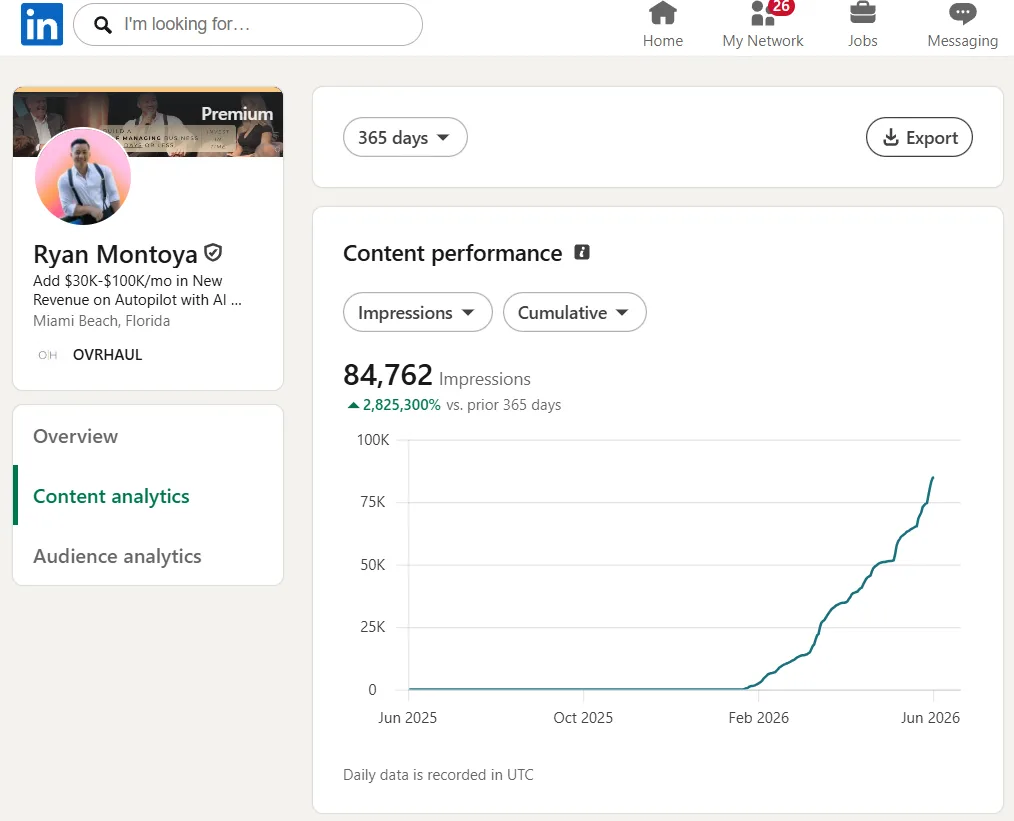
If one is not enough, that is what a call is for. I will walk you through dozens of accounts where we book clients hundreds of calls a month, and a handful where we hit hundreds of calls inside the first few weeks. Come skeptical.
Read this before you run it yourself.
LinkedIn isn't like the other platforms. The upside is bigger and so is the downside.
Here's the part nobody tells you. The algorithm tests every post on a small slice of your audience first. If that slice doesn't bite in the first hour, the post dies right there. String a few of those together and LinkedIn stops trusting your account. Your reach drops on everything after, not just the bad post. You can train the feed to bury you.
A few ways people kill their account without noticing:
- Dropping links straight into the post. LinkedIn wants people staying on-platform, so it throttles anything that pulls them off it.
- Starting before your account is warmed up. Those first few weeks teach LinkedIn whether to trust your account or sit on it. Get them wrong and you can spend months digging out of a hole you dug in days. Some profiles never recover.
- Inconsistency. Post twice then ghost for three weeks, and the system stops trusting you'll show up, so it stops showing you up.
- Wrong audience engaging. If your buddies and recruiters like your stuff but your actual buyers don't, the algo feeds you to more buddies and recruiters. You go viral with the wrong room.
- Bland, safe takes. No comments means no reach. A post that reads like a press release gets zero distribution.
- Engagement bait that backfires. "Agree?" spam and fake polls get flagged, and your account eats a quiet penalty you can't see.
- Pitch-slapping in the feed. Selling too hard, too early gets you muted and unfollowed, which is worse than invisible because now you're actively repelling people.
- Spraying connection requests and copy-paste DMs. Get flagged as spam enough times and LinkedIn restricts you.
- And the worst one, because you never see it happen: a weak profile. Your buyer checks it once. If the headline is vague or the banner is a stock photo, they leave and they don't come back. You never find out which lead you lost. On a 1K-follower account where one follower can be a deal, that's money walking out the door.
Building reach on LinkedIn is slow. Losing it is fast. That gap is the whole reason to get it right the first time.
You Now Have the Whole System.
Profile. Content. Lead magnet. DM flow. Signal outreach. Each piece feeds the next. Your content creates signal. Your signal creates warm conversations. Your conversations route to your profile. Your profile qualifies. Your DM flow books.
Picture 90 days from now. Your profile does the convincing before you ever speak. The right people comment on your posts. A lead magnet goes out and your inbox fills with buyers who already raised their hand. You wake up to booked calls you did not chase. That is what this system does when it runs.
There is one piece you cannot replicate by hand, and I want to be straight about it. You can feel the pattern in your feed, but you cannot score it. What you need is a model that reads every post against 200-plus data points, forecasts a draft's qualified engagement before you hit publish, and gets sharper every week. That, plus a voice model that writes like you instead of like a language model wearing your name tag, is the difference between posting and manufacturing pipeline. It is also the part that takes code, data, and time you probably do not have.
- Build all five pieces yourself, on your own time. Everything you need is on this page.
- Or have us run the engine. You spend ten to fifteen minutes a week approving posts and a handful of real photos. We handle research, drafting, scoring, scheduling, measurement, and intent surfacing.
- Profile and voice model in the first two weeks. Early conversations by week three to six. Consistent inbound by week twelve.
Written June 2026. Numbers on this page come from our own accounts and our clients', measured when written.
They are not a promise of what you will get. Your results depend on your offer, your inputs, and your market.
Tools, prices, and platform policies change over time.